
A good handyman website does four jobs on the first screen: it shows your phone number as a tap-to-call button, names the towns you cover, lists the jobs you actually take, and proves you show up and do clean work. That matters because the jobs are worth real money: Thumbtack puts the typical US handyman rate at $60 to $75 an hour, and most people pay $178 to $220 for a simple task (Thumbtack, 2026).
Disclosure: WebZum makes the website builder described in the how-to section. Competitor and platform facts come from their own pages, checked October 20, 2026. Want to see yours first? WebZum’s AI website builder builds a full handyman site from a short chat, and the preview is free. For contractors who need more than odd jobs, see WebZum for contractors.
Verified October 20, 2026 against the linked sources. Updated from the February 7, 2026 version: we replaced unsourced search-volume and lead-cost figures with cited ones and added California’s new licensing limit.
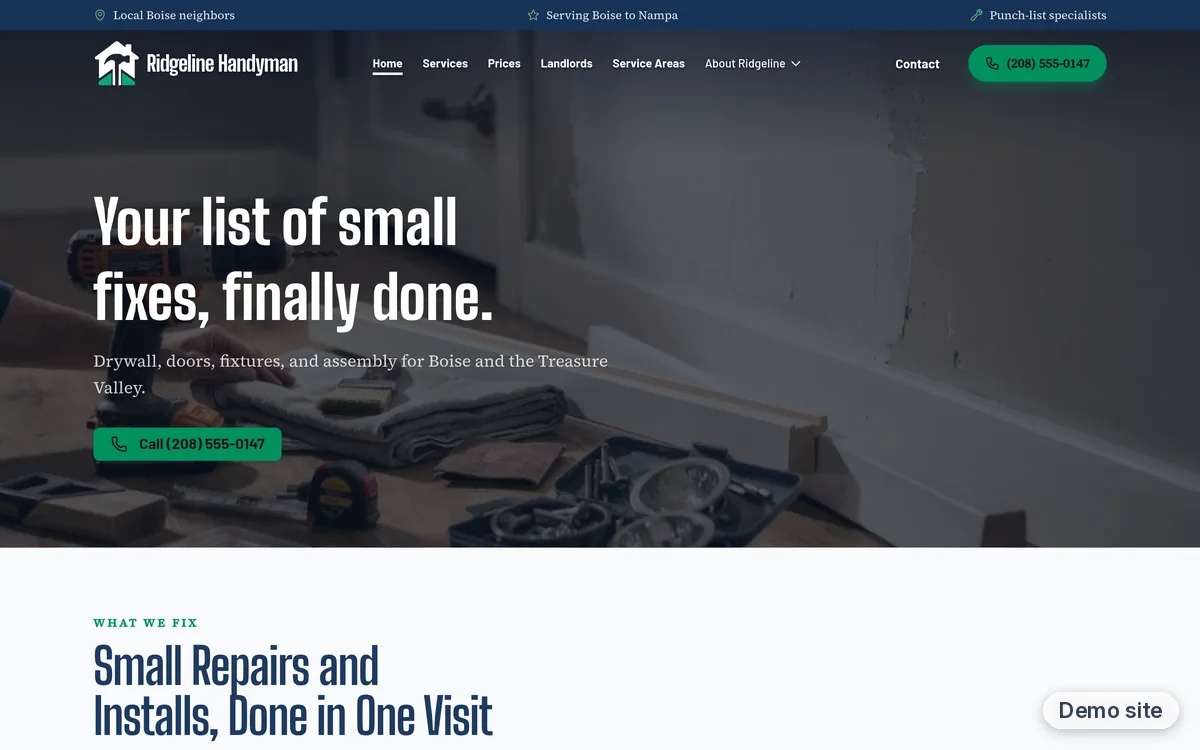
Ridgeline Handyman is a fictional demo site we built with WebZum for this post.
What is the best website builder for a handyman?
The best handyman website builder is the one that gets a working site with your number, towns and jobs online today, because you don’t have nights to spend learning a page editor.
Most handymen don’t need a store, a member area or a fancy layout. They need five pages that load fast and answer a homeowner’s questions before they call. Here’s how the common options compare for that one job:
| Option | Cost | Time to a live site | Who writes the words | Good fit if |
|---|---|---|---|---|
| WebZum | Free preview; Basic $19/mo, Professional $34/mo | About 5 minutes for a multi-page draft | The AI writes it from your chat; you edit by chat | You want a full site today and changes by typing a sentence |
| A drag-and-drop builder (Wix, Squarespace) | Varies by plan; check their pricing pages | Hours to days | You | You like designing pages yourself |
| A local web designer | Usually a one-time project fee plus upkeep | Weeks | The designer, from your notes | You want someone else to own it start to finish |
| Only a Thumbtack or Angi profile | Free to join; you pay for leads | Same day | You, in their template | You want leads now and don’t mind paying per lead |
Choose a designer instead if you want a custom booking system or someone who will run your marketing month to month. Choose a drag-and-drop builder if you enjoy design work. Choose WebZum if you want the whole site written for you and live the same day.
Why does a handyman need a website if Thumbtack and Angi send leads?
Because a lead platform charges you to talk to a customer, and your own site doesn’t.
Thumbtack says that leads matching your job preferences are paid for automatically, and for its Opportunities you pay if the customer responds (Thumbtack Help). Angi’s lead-credit rules list “You did not win the job” and “Consumer is just shopping” as situations that are already priced in and don’t get a credit (Angi lead credit guidelines). A call that comes from your own website reaches you alone, and nobody bills you for it.
Platforms still have a place. They’re a fine way to fill a slow week. The problem is depending on them for every job.
Homeowners also check you out before they call. In BrightLocal’s 2026 survey, 97% of consumers read reviews for local businesses, and 47% won’t use a business with fewer than 20 reviews (BrightLocal, Local Consumer Review Survey 2026). The same survey found 45% now use ChatGPT or other AI tools for local recommendations, up from 6% the year before. A site that clearly says who you are, where you work and what you fix gives both people and AI tools something to point to.
How much is a handyman job worth?
Enough that one job covers months of a website.
HomeAdvisor puts handyman projects at $65 to $1,200, with $390 as the average, and hourly quotes at $60 to $125 plus materials (updated June 17, 2026) (HomeAdvisor). Thumbtack puts more complex handyman projects at $701 to $1,105 on average (Thumbtack).
The work itself is steady. The US Bureau of Labor Statistics counts about 1.62 million general maintenance and repair workers in 2025 and projects 4% growth through 2035, with a median wage of $49,590 (BLS Occupational Outlook Handbook). That’s employed workers, not independent handymen, so treat it as a sign of demand rather than a head count of your competition.
A worked example with real numbers
Here is the math we’d do for our own site, using only the prices above:
- A WebZum Basic site is $19 a month, or $228 a year.
- One simple task, at Thumbtack’s typical $178 to $220, covers most of that year.
- One average HomeAdvisor-sized job at $390 covers the whole year with money left over.
That doesn’t mean the site will bring a set number of jobs. It means the bar for paying for itself is one or two calls a year, and the calls you do get come without a per-lead charge.
What should a handyman website include?
Four things on the first screen, and three pages behind them.
On the first screen:
- A tap-to-call button. Most people deciding on a handyman want to talk to one. Put the number at the top, big.
- Your towns. “Handyman in Plano, Frisco and Allen” beats “serving the area.” Google lets service businesses list up to 20 service areas on their Business Profile, and if you don’t meet customers at your address you should remove it and list only the areas (Google Business Profile Help). Use the same towns on your site.
- The jobs you take, by name. Drywall patches, TV mounting, door repair, furniture assembly, caulking, light fixtures. People search for the job, not the word “handyman.”
- Proof. A few before-and-after photos and your best reviews.
Behind it:
- Services: one short section per job, with what’s included and roughly how long it takes.
- About: your name, your face, how long you’ve done this, and whether you’re licensed or insured where that applies.
- Contact: phone, a short quote form, your hours, and how fast you get back to people.
Do I need a license to advertise handyman work?
It depends on your state, and the rules changed recently in California.
Since January 1, 2025, California lets an unlicensed person take jobs under $1,000 total (labor and materials) only if the work needs no building permit and they don’t hire anyone to help (CSLB, AB 2622 bulletin). The old limit was $500, and some cost guides still quote it. If you advertise under that exemption, the ad must say you’re not licensed. CSLB lists penalties for unlicensed contracting of up to $15,000 in administrative fines (CSLB press release).
So check your state board before you write “licensed” on your site, and write it if you are. It’s one of the first things homeowners look for.
How do I build a handyman website with WebZum?
Type a sentence about your business, answer a few questions, and you’ll have a multi-page draft in a few minutes.
- Start on the home page. Type something like “Owner-run handyman in Plano, TX. Drywall, doors, TV mounting, small plumbing fixes. 12 years, insured.” If you have a Google Business Profile, paste its Google Maps link instead: WebZum can pull up to five of your Google reviews and your overall rating and use them to write your trust copy.
- Answer the short chat. About four questions, then hit Build.
- Look at the preview. You’ll get a home page, service pages, an about page and a contact page, with photos and a logo.
- Fix things by typing. “Add gutter cleaning to the services.” “Change the phone number.” “We’re closed Thanksgiving Day.” You don’t drag boxes around, and if a change goes wrong you can ask it to undo.
- Optionally, promote it on Google. The editor can draft a Google search ad from your site, with a call button and a service radius, for when you want calls faster than search will bring them.
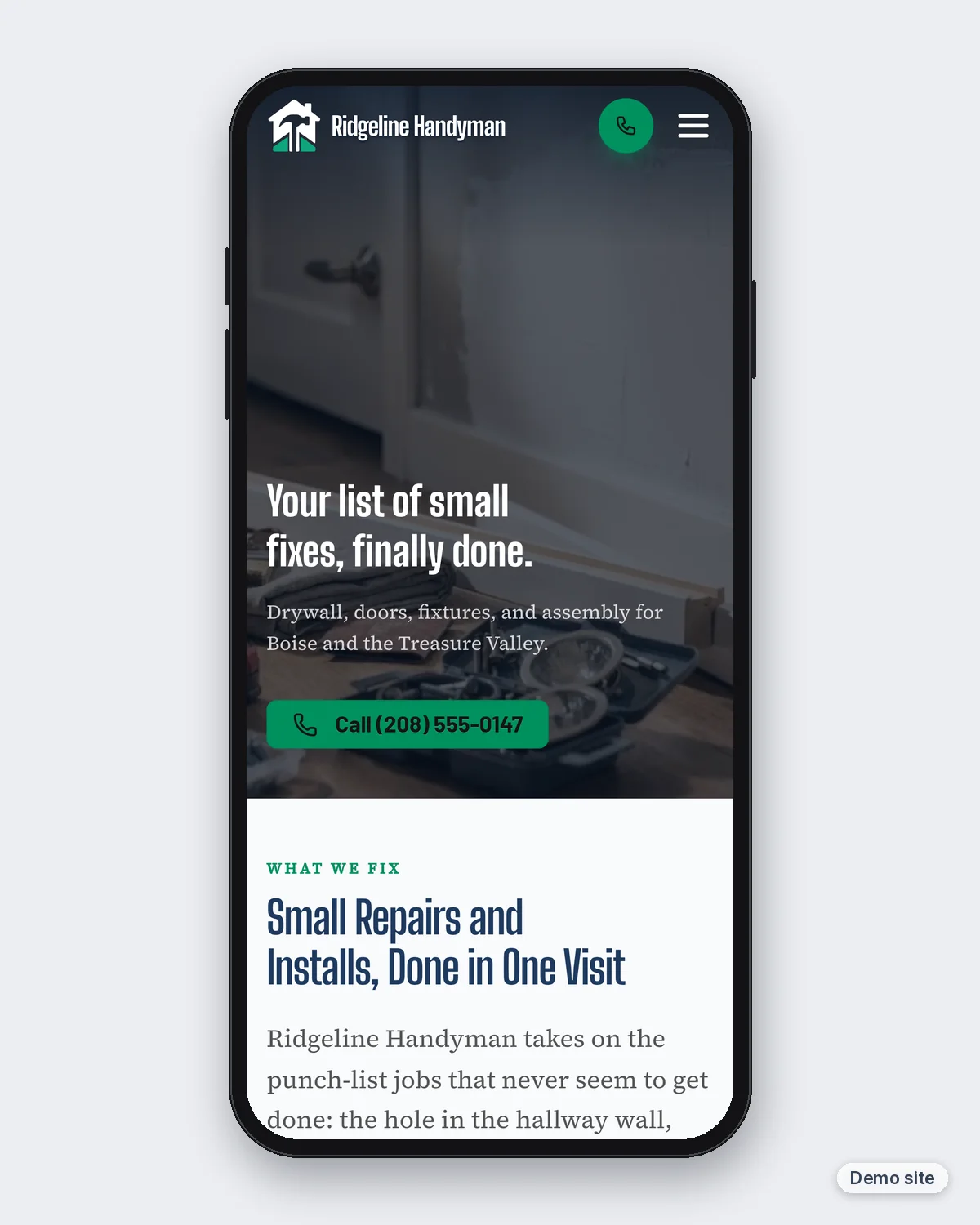
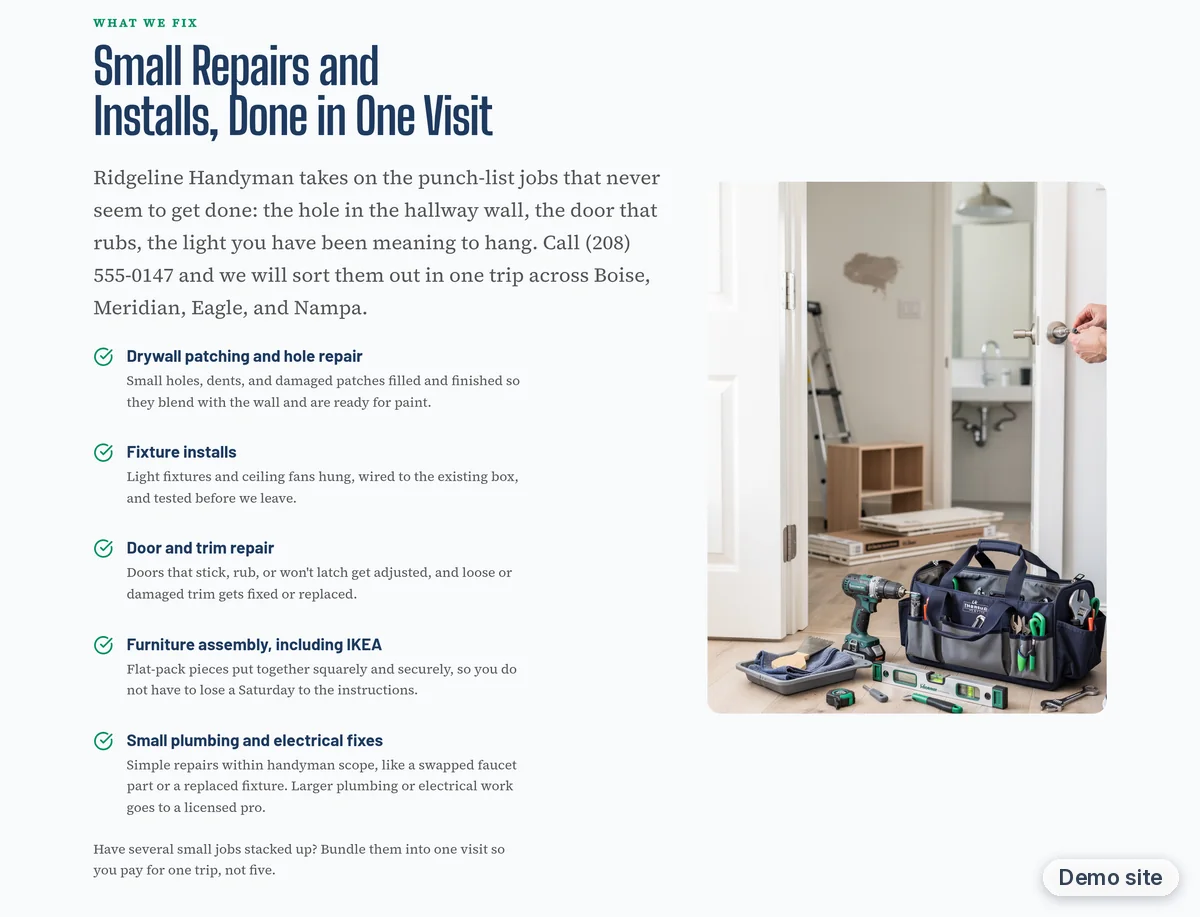
Your site works the same on phones, tablets and computers, so it looks right whether a homeowner finds you on the couch or at their desk.
How do I compete with Mr. Handyman and the big franchises?
Be specific and be local.
A franchise site has to cover hundreds of towns. Yours can name your exact neighborhoods, your exact jobs and your own face. Search for the job plus your town and see who shows up, then make a page that answers that search better. If you want more on the search side, read our local SEO checklist for small businesses and how long it takes Google to index a new website.
FAQ
What is the easiest way to build a handyman website?
Use a builder that gets your number, towns and jobs online fast and lets you change them without learning an editor. With WebZum, you type a sentence about your business, answer a few questions, and get a multi-page draft in a few minutes. The preview is free, so you can see the whole site before you pay.
How much does a handyman website cost per month?
With WebZum, Basic is $19 a month and Professional is $34 a month, and every plan has a 30-day money-back guarantee. That’s a flat cost, unlike lead platforms that charge per lead. For other options, see our breakdown of small business website costs in 2026.
Do I still need Thumbtack or Angi if I have a website?
Not necessarily, but many handymen keep a profile to fill slow weeks. Thumbtack and Angi charge you for leads, including ones you don’t win, while a call from your own site costs nothing per lead. The goal is not depending on platforms for every job.
What pages does a handyman website need?
Home, services, about and contact. The home page should show a tap-to-call button, your towns, the jobs you take by name, and proof like before-and-after photos and reviews. Services gets a short section per job, About shows your name, face and whether you’re licensed or insured, and Contact has your phone, a quote form and your hours.
Can I say I’m licensed on my website?
Only if you are. Since January 1, 2025, California lets unlicensed handymen take jobs under $1,000 with no building permit, and any ad under that exemption must say you’re not licensed. Check your state board first, and if you are licensed, say so clearly, since it’s one of the first things homeowners look for.
Get your handyman site in front of homeowners
Every job you list, every town you name and every review you show is one more reason for a homeowner to call you instead of scrolling past. See it for yourself: build your free handyman website preview. You can also compare notes with our guides for plumbers and contractors, or read what makes a website get the call.